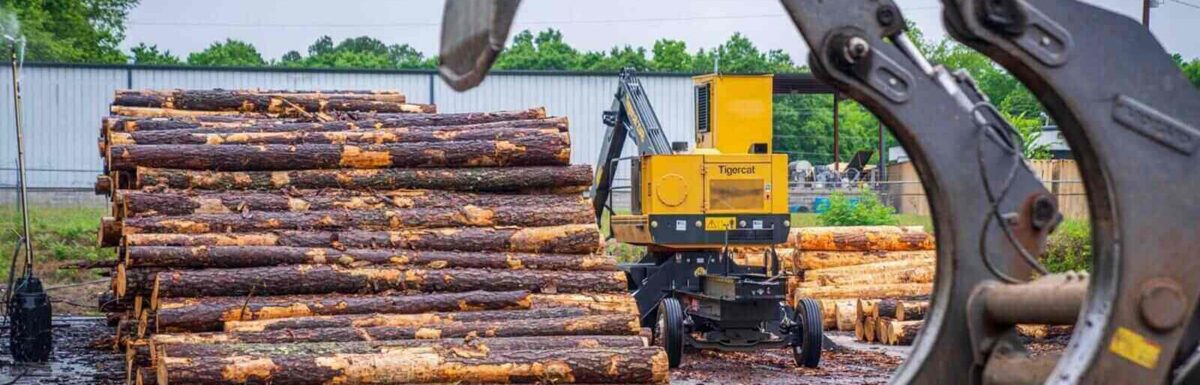
Some Virginia crews sit out a month or longer when the ground is too soft to skid on or the mill cuts their quota. That’s a good time to look at how you’re insuring idle logging equipment.
A few adjustments save money without much downside. Trim the wrong coverage, though, and a parked skidder or log truck could end up uninsured just when you need it.
Theft, Fire, and Storm Losses on Parked Machines
A landing deep in the woods may go weeks without a visit from your crew. In the meantime, a stolen grapple saw or a pine across the boom may go unnoticed.
Logging equipment is typically carried on an equipment floater, a form of inland marine insurance, instead of the property policy for your shop. Building coverage is generally tied to a street address. A skidder parked on a tract 40 miles away may fall outside it.
With a floater, the machines you’ve listed are insured wherever they sit, as long as they’re inside the territory named in your contract.
Tigercat, the forestry equipment maker, flags debris jammed around hot exhaust parts as a major fire risk in its safety guidance. Before you park anything, wash or blow out the engine bay and belly pans. Take a few pictures afterward, and you’ll have proof of what each machine looked like on the first day of the shutdown.
Dried-out hydraulic seals and a rusty boom get filed under wear and tear. A lot of equipment forms won’t pay for that category. Rodent damage is often capped or excluded, too.
Mice will nest in a quiet cab and can chew a wiring loom to pieces before spring. Pull the battery cables and check for droppings before everyone heads home.
Deciding Which Coverages to Keep, Reduce, or Suspend
Equipment Physical Damage
Dropping physical damage on a parked machine means there’s nothing to collect if it’s stolen from an empty landing. Pull out the loan or lease paperwork before you change a thing. Lenders usually want physical damage protection in place until the last payment clears. A lapse could put you in default.
Raising the deductible on your logging equipment insurance for the months you are shut down is often a better way to look for savings.
Log Trucks and Commercial Auto
For a log truck that’s parked for the season, ask your carrier about a lay-up or storage endorsement on your commercial auto policy. Where it’s offered, the insurer suspends liability and collision while the rig sits and leaves other-than-collision coverage on for fire and theft.
Virginia’s Department of Motor Vehicles wants you to deactivate the plates before you cancel the required insurance on a registered vehicle. Get it wrong, and your license and the truck’s registration could both be suspended. Apportioned plates for interstate hauling may follow separate rules.
Liability and Workers’ Compensation

General liability and workers’ compensation are commonly rated on payroll or receipts. When the carrier audits your books at the end of the term, the final premium is typically adjusted for the slower months.
Hunters and kids on four-wheelers sometimes wander onto an empty landing and climb on the equipment. If one of them falls off your loader, you could be looking at a liability claim.
In Virginia, a business that regularly keeps more than two people on the payroll generally needs workers compensation coverage. A mechanic who stays on through the winter to rebuild a harvester head may still count toward that number. If you drop workers’ compensation mid-shutdown, an injury during that shop work could go uninsured.
Storage Decisions and Records That Hold Up at Claim Time
Before you decide where the machines will sit, find the protective safeguards section in your equipment policy. Some carriers pay theft claims only if certain precautions are in place, such as a locked yard or a working GPS tracker.
Trucking every machine back to a fenced yard burns fuel and time. When one has to stay on the landing, park it out of sight from the road and block the entrance with a few cull logs. Let your agent know where each unit will be stored and for roughly how long. The agency can then flag any conflict with your contract terms before the crew pulls out.
While you’re taking condition photos, write down the hour meter reading, serial number, and PIN for every machine. Keep a copy at your house or in a cloud folder. Paperwork stuffed in a cab or the shop office can go up in the same fire as the machines.
With those records, you can document value and condition on a stored equipment coverage claim. Law enforcement also relies on serial numbers and PINs when trying to match a recovered unit to its owner.
Cutting Premium Without Creating a Coverage Gap
You can shave premium by lowering the scheduled value on a parked machine. Many equipment forms include a coinsurance provision, though. Under it, the insurer may cut your settlement when the limit is lower than a set share of the unit’s actual value.
In one example from University of Florida training material, a $100,000 machine is insured for just $40,000 against an 80% requirement. Full compliance would take $80,000 of coverage. Because the owner bought half of that figure, the insurer would pay roughly half of any covered loss, before the deductible.
A midterm cancellation may come with a short-rate penalty, where the refund on unused premium falls short of a straight day-by-day calculation. A new policy when work resumes may also mean fresh underwriting or another inspection.
In many cases, an endorsement for reduced use is the simpler path. Your off-season logging equipment protection also stays intact that way.
Call your agent before you haul the first load to the mill. Any coverage you reduced or suspended, especially liability and collision on the trucks, should go back into force beforehand. Take sold machines off the equipment schedule and add new purchases before you run them on a job.
Plan Your Shutdown Coverage With Burton & Company
Burton & Company has been placing coverage for Virginia businesses since 1891. Because we work with several carriers, our team can show you how each handles lay-up endorsements and storage requirements. We can also sit down with your equipment schedule and truck policies before the crew parks for the season.
If your setup already works for a shutdown, we can tell you that and leave it alone. Call (888) 652-1046 or request a quote to set up a time to go over your coverage.